
Singaporean Travel Astrologer Posts Viral Prediction of Middle East Conflict Days Before It Happened
Singaporean travel astrologer posts reel predicting the Middle East conflict just days before.

A reel posted just days before the Middle East conflict went viral for accurately predicting when and where it would happen. Natalia, the Singaporean creator behind @astronatofficial, went from brand new to international headlines in under a week through her prediction.
Also read: Dubai Airport Closure: Middle East Flight Updates For Singaporean Travellers
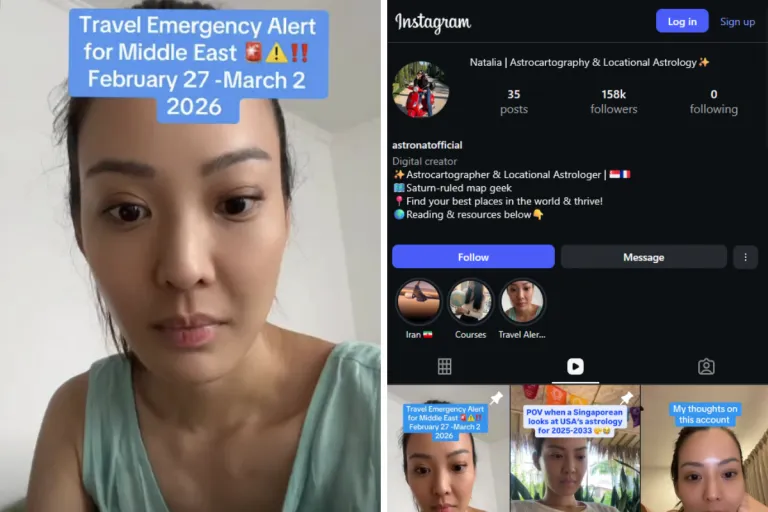 Image credit: Natalia @astronatofficial
The Singaporean creator behind @astronatofficial
Natalia describes herself as an astrocartographer and locational astrologer, and her content reflects that niche almost entirely. On @astronatofficial, she helps followers identify the world's best destinations through planetary lines and astrological charts, with a bio that reads simply: "Find your best places in the world and thrive."
Particularly striking is how she fast-tracked her way into the spotlight. As recently as 24 February, she was introducing herself to new followers and noting that @astronatofficial was still a new account. Just days later, her Middle East reel was circulating across platforms internationally, picked up by News18, the Economic Times, and news.com.au. For a Singaporean creator still building her digital presence, that is a remarkable trajectory.
Astrocartography, explained simply
To understand why her warning resonated, it helps to know what astrocartography actually is. Developed in the 1970s by American astrologer Jim Lewis, it is a branch of locational astrology that maps planetary energies onto specific locations around the globe. The core idea lies in different places activate different planetary influences, and those influences shape what a person experiences there.
In practice, an astrocartography map overlays a series of lines onto a world map that each corresponds to a different planet. Where those lines fall, astrologers argue, is where that planet's energy concentrates most strongly.
The ten planetary lines and what they mean
Uranus sat at the centre of Natalia's warning.
A standard map draws on ten celestial bodies: the Sun, Moon, Mercury, Venus, Mars, Jupiter, Saturn, Uranus, Neptune, and Pluto. Each carries a broad set of associations:
Sun lines: visibility, confidence, and vitality; popular for career-focused travel
Venus lines: romance, creativity, and aesthetic pleasure; frequently recommended for leisure
Jupiter lines: expansion, luck, and abundance; often suggested for new ventures
Mars lines: energy, drive, and conflict; considered high-intensity and sometimes volatile
Saturn lines: discipline and challenge; useful for focused work, taxing for holidays
Uranus lines: disruption, sudden change, and unpredictability
The Viral Video
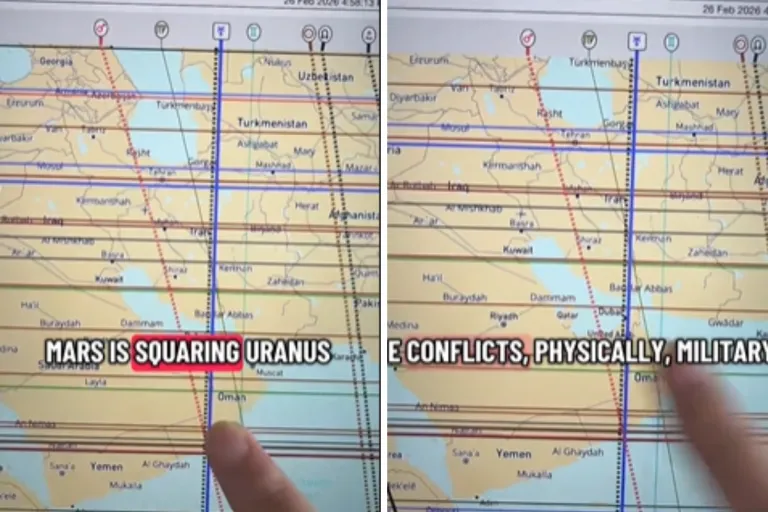 Image credit: Natalia @astronatofficial
In the video posted on 26 February, Natalia identified a transit of Mars in Aquarius squaring Uranus in Taurus between 27 February and 2 March. She then overlaid that transit onto her astrocartography map and observed that the relevant planetary lines ran directly across Iran and through the Gulf region. Together, she argued, those alignments pointed to a high probability of territorial conflict, collective unrest, and major travel disruptions.
Her advice was practical rather than alarmist. She urged followers to avoid non-essential travel to Iran, the UAE, and Oman during that window, and above all to secure comprehensive travel insurance. "Do not save money on this for the love of Uranus," she wrote, a line that went on to circulate widely in screenshots. She also drew a clear boundary around her role: "Guys, I'm a travel astrologer, not a war general.
When US and Israeli forces struck Iran on 28 February, airspace closures rippled across the region almost immediately, grounding flights out of Tehran, Tel Aviv, Baghdad, and Dubai. Screenshots of her reel flooded comment sections, and one user's reply captured the mood: "Wish I saw this — now stuck in Dubai with my two-year-old."
Takeaways
The prediction's match between Middle East conflict and the timeline is compelling, but it is not enough reason to swap your MFA travel advisory for an astrology app. As far as evidence today suggests, astrocartography is an interpretive practice, not a geopolitical forecasting tool, and the overlap in timing remains a coincidence by any verifiable measure.
Also read: NATAS Fair March 2026: Dates, Directions, and Details
Still, the episode is a timely reminder to travel better prepared. Here are some tips that actually helps:
Check the Ministry of Foreign Affairs Travel Advisory portal before booking any trip to volatile regions.
Buy travel insurance that covers trip cancellations, medical evacuation, and airspace disruptions. Be sure to check the fine print carefully.
Monitor airline communications if your route connects through Gulf hubs such as Dubai, Doha, or Abu Dhabi.
Build flexibility into your itinerary, especially on routes where one airspace closure can cascade across an entire journey.
Always be sure to cross-check any information with official governmental sources on the most updated travel news.

About Author

Her motto is "experience everything at least once". An adrenaline junkie at heart, she is always down for spontaneous adventure, especially to exotic destinations. She finds the most meaningful aspect of travel is cultural immersion, and talking to locals is an underrated travel hack.