
How to Use AI for Travel Planning to Avoid Costly Mistakes
A group of Israeli travellers were detained at Kuala Lumpur International Airport (KLIA) in March 2026 after trusting an AI chatbot's transit advice. Don't let this be you with these tips.

A group of Israeli travellers were detained at Kuala Lumpur International Airport (KLIA) in March 2026 after trusting an AI chatbot's transit advice.
Don't let this be you. But that doesn't mean you have to give up on AI tools entirely. What went wrong at KLIA can be avoided by tweaking how you approach AI use in planning your travels. Read until the end for practical guidance on how to use AI for travel planning in a way that keeps you informed, not stranded.
Also read: NATAS Travel Fair March 2026: The Best Asia Travel Deals!
When AI Gets It Wrong: The KLIA incident
 Image credit: Bernama
In late March 2026, a group of young Israeli travellers found themselves stranded at Kuala Lumpur International Airport (KLIA) after consulting an AI chatbot for travel advice. Four travellers were stopped while changing flights from Thailand to the Philippines. Two of the women, both travelling on Israeli passports, were detained and eventually returned to Thailand.
In a separate incident, two Israeli men travelling from Cambodia to the Philippines via Malaysia were held for two days before being deported back to Cambodia.
 Image credit: Craig via Wikicommons
In total, at least eight Israeli nationals have been detained at KLIA in recent months, some holding dual citizenship. Malaysia does not have diplomatic relations with Israel, and Israeli passport holders face strict barriers to entry or transit. This echoes travel advisories issued by Israel's National Security Council.
Despite all of this, an AI chatbot reportedly assured the travellers the route was safe. The detained travellers were only allowed to proceed with their journeys following the intervention of Israeli diplomatic officials based in Singapore.
Israel's ambassador to Singapore, Eliyahu Vered Hazan, said the individuals had not committed any offences. "All those detained had not broken any law or committed any offence. The only reason for their detention was that they were Israeli," he was quoted as saying.
This is not an isolated risk. Travel experts warn that AI chatbots frequently contain outdated information, recommend attractions that no longer exist, provide incorrect visa requirements, or omit critical entry details. As of 2026, most travel insurance policies do not cover losses stemming from AI-generated errors, leaving travelers vulnerable to bearing the cost of these mistakes. Knowing how to use AI for travel planning: and where it falls short, has never been more important.
How To Plan a Trip using AI
AI is a powerful research assistant, not an immigration lawyer. It can't discern which advice is not relevant for your specific situation. Therefore, understanding how to use AI for travel planning correctly can mean the difference between a smooth trip and a 48-hour detention. Here are some practical tips to get the most out of AI without putting yourself at risk.
 Image credit: Vlada Karpovich from Pexels
Be specific about your passport and routing
The biggest mistake travellers make is asking vague questions. Refrain from typing a vague prompt like:
Can I transit through Malaysia to the Philippines?
Instead, give AI a fuller picture. Try a more specific, context-inclusive prompt like:
I am a Singaporean passport holder transiting through Kuala Lumpur International Airport en route to Manila. Are there any entry restrictions, diplomatic considerations, or transit-specific rules that could affect me? Please highlight areas of uncertainty and point me to official sources to verify.
Specifying your nationality and exact travel route gets you a far more relevant and honest response.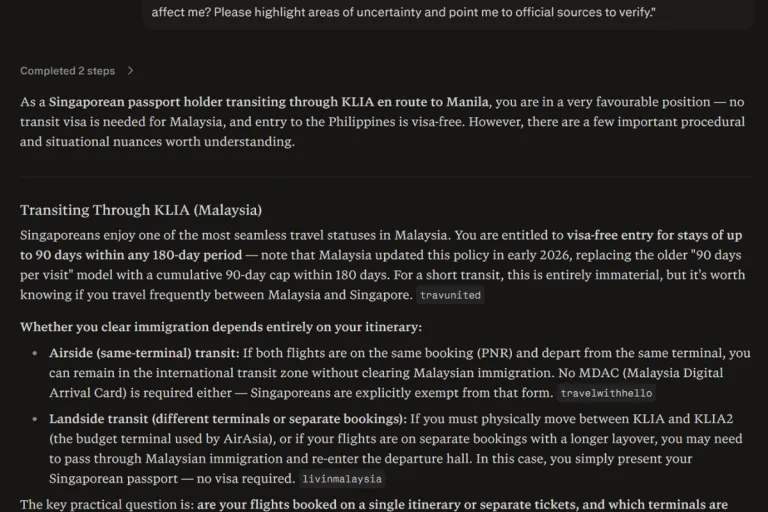
Additionally, always ask the AI tool to flag where its information could be outdated, since not all of them have web access and immigration policies change frequently.
Use AI for planning, not compliance
AI excels at building itineraries, comparing flight routes, and drafting packing lists. However, it should never be your final authority on visa requirements or entry bans. For those, always re-verify with official government portals of your destination country. For instance, approach the Immigration & Checkpoints Authority (ICA) for Singapore-specific queries. Your destination country's immigration website is typically another foolproof option.
For flights, try a prompt like:
I am a Singaporean passport holder looking for the most cost-effective return flights from Singapore to London in July 2026. I want to avoid transiting through countries with complex visa-on-arrival requirements or known entry restrictions for Singaporean travellers. What are the best airline and routing options?
This level of specificity helps AI deliver actionable, relevant results rather than generic suggestions.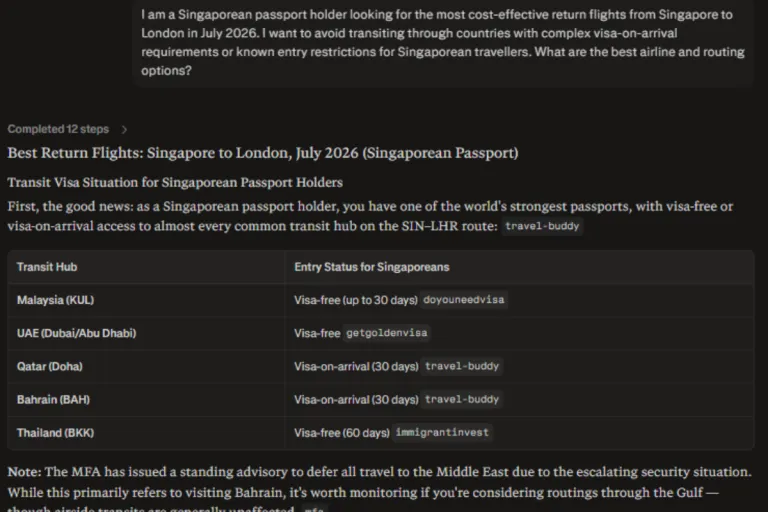
Ask AI to Acknowledge Its Own Limits
One of the smartest habits when learning how to use AI for travel planning is to ask the chatbot to flag where it might be wrong. Try something like:
What are the current entry requirements for Singaporeans visiting Jordan in 2026? Please note if any part of this information could be outdated and tell me where I should verify it officially.
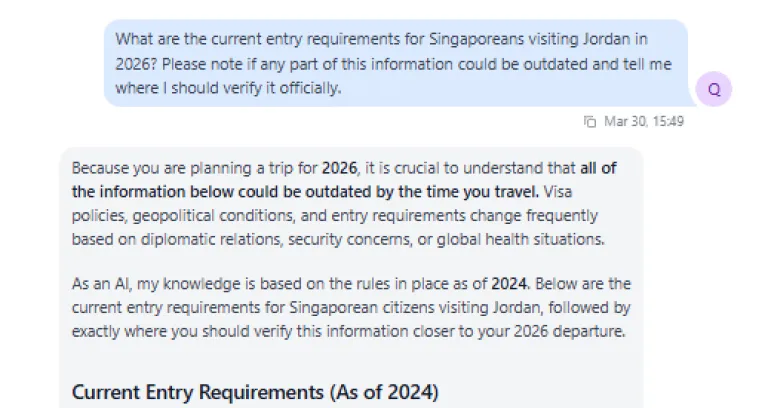
Asking this way keeps you informed of the AI's blind spots, and reminds you to double-check before you confirm your booking.
Also read: Top 10 World's Biggest Airports: KLIA is The Largest in Southeast Asia
The Golden Rule
 Image credit: Matheus Bertelli from Pexels
Use AI as your starting point, not your finish line. Let it generate ideas, shortlist destinations, and map out a rough itinerary. But before you lock in any transit through an unfamiliar hub, spend the five minutes on your government's official travel advisory page. It could save you the uncomfortable experience of 48 hours in an airport detention room. The same goes for the rest of your itinerary: simply searching for recent updates on social media or the local maps app can save you a wasted trip.
The KLIA incident is a timely reminder that even the most sophisticated AI tools are only as reliable as the data they were trained on, and that data is only as useful as its an expiry date. AI tools may seem impressive with the quantity of work they can achieve in a short time, but their reliability still leaves room to be desired.

About Author

Her motto is "experience everything at least once". An adrenaline junkie at heart, she is always down for spontaneous adventure, especially to exotic destinations. She finds the most meaningful aspect of travel is cultural immersion, and talking to locals is an underrated travel hack.