
A Day Trip Itinerary to Kurama and Kibune in Rural Kyoto
Tired of Japan’s bustling cities? Take a day trip to Kurama and Kibune in rural Kyoto to discover their hidden gems!

Kyoto’s famous temples and historic neighbourhoods could easily fill an entire holiday. However, travellers willing to venture beyond the city centre will find a quieter side of the destination among the forested mountains of Kurama and Kibune.
These two small communities in northern Kyoto are connected by a scenic mountain trail passing through Kurama-dera Temple. Along the way, visitors encounter cedar forests, legendary Tengu, sacred shrines and some of the region’s most atmospheric landscapes.
The journey can be completed in a day, although comfortable shoes and an early start are essential.
Here is how to plan a day trip to Kurama and Kibune from Kyoto.
Meet the guardians of the mountain
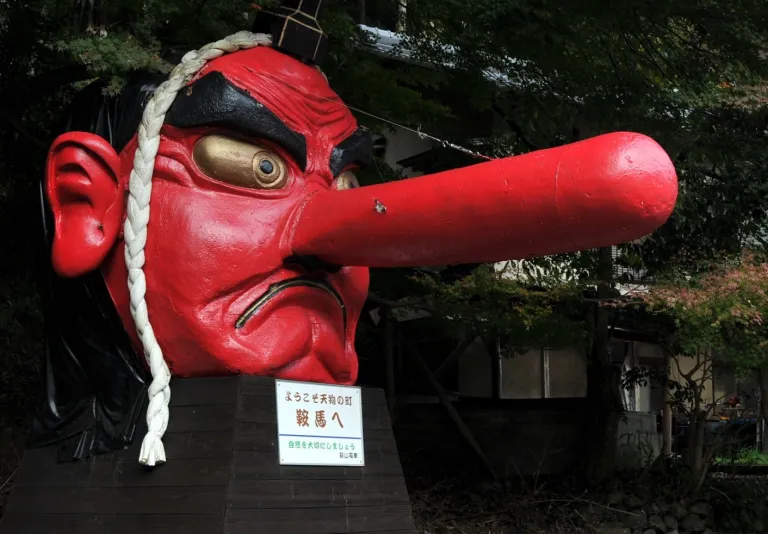
Sōjōbō, the Tengu boss who lives in and protects Mount Kurama | Image credit: lj16
Begin by taking the Eizan Railway from Demachiyanagi Station to Kurama Station.
The journey takes approximately 30 to 40 minutes and gradually replaces Kyoto’s urban scenery with wooded hills and smaller settlements.
Outside Kurama Station, visitors are greeted by a large red-faced Tengu statue. These mythical beings are closely connected to Mount Kurama and are often depicted with long noses, red faces and supernatural abilities.
According to local legends, Sōjōbō, the king of the Tengu, lived on Mount Kurama and taught swordsmanship to the young warrior Minamoto no Yoshitsune.
From the station, it is only a short walk to Kurama’s main street, Kurama Onsen and the entrance to Kurama-dera.
Soak in outdoor onsens with a view to die for
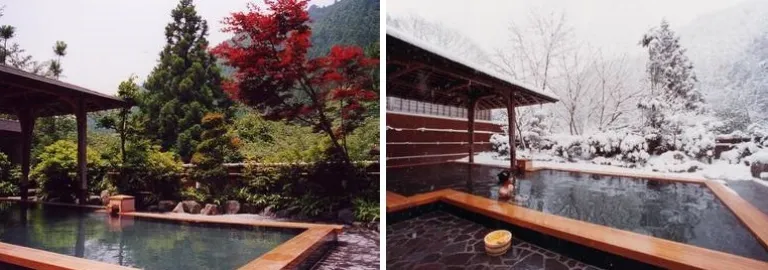
A beauty no matter the season | Images credit: Japan Experience
Kurama has long been known as a peaceful mountain retreat, and Kurama Onsen is one of the area’s most relaxing attractions.
The hot-spring facility reopened in 2024 after a lengthy closure and once again offers day-use bathing. Its outdoor bath is surrounded by forested slopes, allowing visitors to enjoy the scenery while soaking in the mineral-rich water.
Bathing before the hike can provide a leisurely start to the day, although many travellers may prefer to return after exploring Kurama-dera rather than hiking immediately after a hot soak.
Japanese bathing rules apply. Wash thoroughly before entering the water, do not wear swimwear and keep towels out of the bath. Tattoo policies and operating arrangements may change, so confirm the latest conditions before visiting.
Travellers determined to complete the full Kurama-to-Kibune hike and eat lunch in Kibune should avoid spending too long here in the morning.
Discover your inner cosmic energy at Kurama-dera
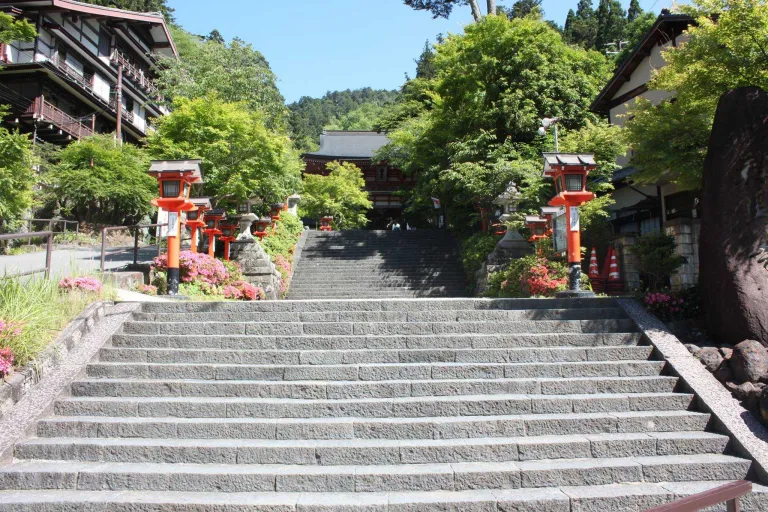
From the village, walk to the Niomon Gate marking the entrance to Kurama-dera Temple.
The temple was founded more than 1,200 years ago and spreads across the forested slopes of Mount Kurama. Visitors can climb on foot or use the temple’s short cable railway to bypass part of the initial ascent.
Walking provides the more atmospheric experience, with stone steps and forest paths leading past small religious structures and towering cedar trees.
One of the first significant stops is Yuki Shrine, known for the annual Kurama Fire Festival. The shrine sits beneath enormous trees and contains a sacred Japanese cedar believed to be several centuries old.
Continue uphill towards Kurama-dera’s main hall, pausing at viewpoints and smaller temple buildings along the way.
Visit Kurama-dera’s main hall
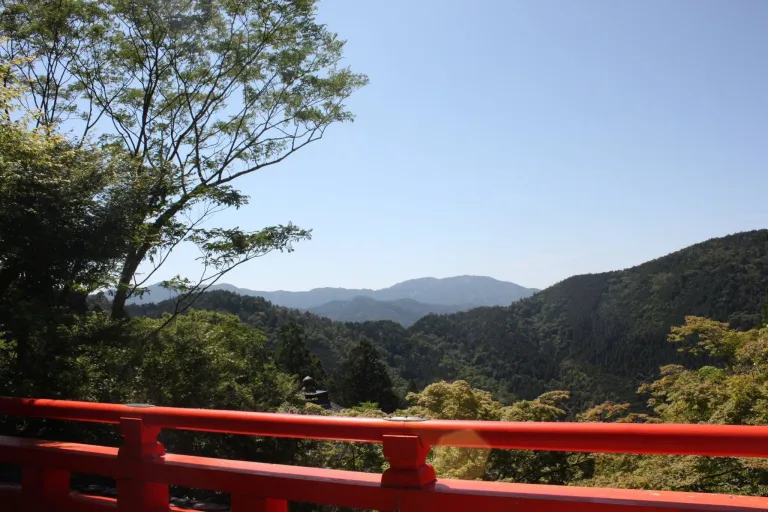
Kurama-dera’s main hall stands on an elevated terrace overlooking the surrounding mountains.
In front of the building is a geometric stone pattern commonly known as the Kongosho. Many visitors stand at its centre, which is regarded as a place where the spiritual energy of the mountain is concentrated.
The temple’s beliefs centre on the energy of the universe and the interconnectedness of love, light and power. While the site has become widely described as a “power spot”, visitors should remember that it remains an active religious complex rather than merely a photography location.
Take time to admire the mountain view, explore the grounds and rest before beginning the forest hike towards Kibune.
Travellers who do not wish to complete the full trail can descend to Kurama Station and travel to Kibune using the railway and local bus instead.
Take the sacred mountain trail from Kurama To Kibune
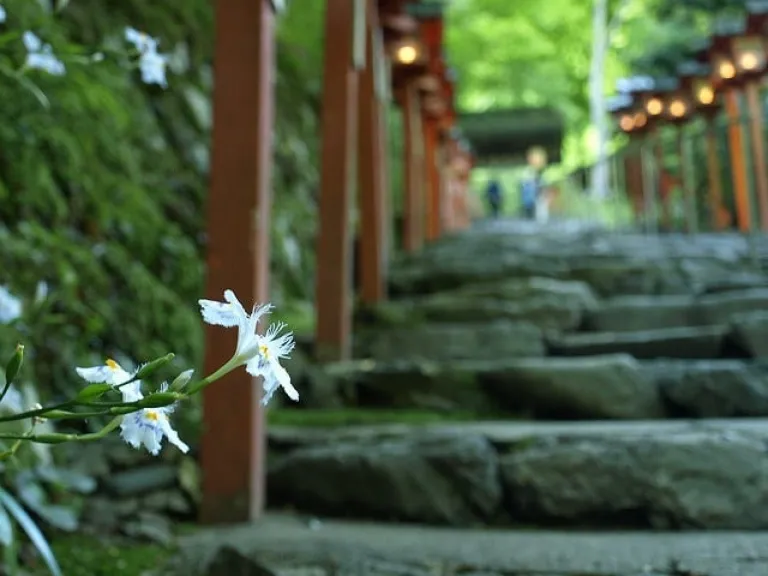
Find beauty even in the smallest of things | Image credit: merec0
Behind the main temple area, the path continues across Mount Kurama towards Kibune.
The complete walk from Kurama through the temple grounds to Kibune covers roughly four kilometres and usually takes around two to three hours, depending on fitness, weather and sightseeing stops.
Although frequently described as a beginner-friendly hike, the trail contains steep stairs, exposed roots and uneven surfaces. The descent towards Kibune can be particularly demanding on the knees.
Wear proper walking shoes and avoid attempting the route during heavy rain, snow or icy conditions. Trail access can also be affected by fallen trees and maintenance work, so check locally before setting off.
Along the route, look out for the Yoshitsune Sekurabe Ishi, or Height-Comparing Rock. Legend holds that Minamoto no Yoshitsune used the rock to measure his height while training on the mountain.
Walk carefully through Kinone Sando
One of the trail’s most distinctive sections is Kinone Sando, or the Tree Root Path.
Because the soil is shallow and hard, the cedar roots spread visibly across the surface, creating a dramatic network along the forest floor.
The roots are photogenic but vulnerable. Walk along the marked route and avoid stepping directly on them whenever possible.
Mount Kurama is also associated with Mikao Usui, the founder of the modern Reiki healing practice. Tradition holds that he meditated and fasted on the mountain before experiencing the spiritual revelation that shaped his teachings.
Continue past forest shrines including Fudo-do and Oku-no-in Mao-den before beginning the long descent towards Kibune.
A red bridge near the base of the mountain signals the end of the trail and your arrival in the village.
Enjoy riverside dining in Kibune
Kibune is famous for kawadoko, a summer dining tradition in which platforms are constructed directly above the Kibune River.
The rushing water beneath the platforms can make the temperature feel noticeably cooler than in central Kyoto, which explains why the experience is especially popular during the hot summer months.
Several restaurants along the river serve seasonal set meals and kaiseki cuisine. Reservations are generally recommended, particularly during weekends and peak summer periods.
One of the best-known establishments is Hirobun, which offers nagashi somen during the warmer months.
Fish for your Nagashi Somen at Hirobun
Nagashi somen transforms lunch into a small test of coordination.
Thin noodles travel through channels of cold flowing water, and diners use chopsticks to catch them before dipping them into sauce.
Hirobun’s experience is highly popular and may operate on a first-come, first-served basis, with waiting times stretching considerably during busy periods. Service is also seasonal and can be suspended because of high water, rain or other operational conditions.
Arrive early, but do not assume that reaching the restaurant at a particular time guarantees immediate seating.
Travellers unable to join the flowing-somen experience can reserve one of Hirobun’s seasonal meals or choose another riverside restaurant nearby.
Kawadoko dining and nagashi somen are primarily summer experiences. Outside the season, restaurants may serve meals indoors or operate different schedules.
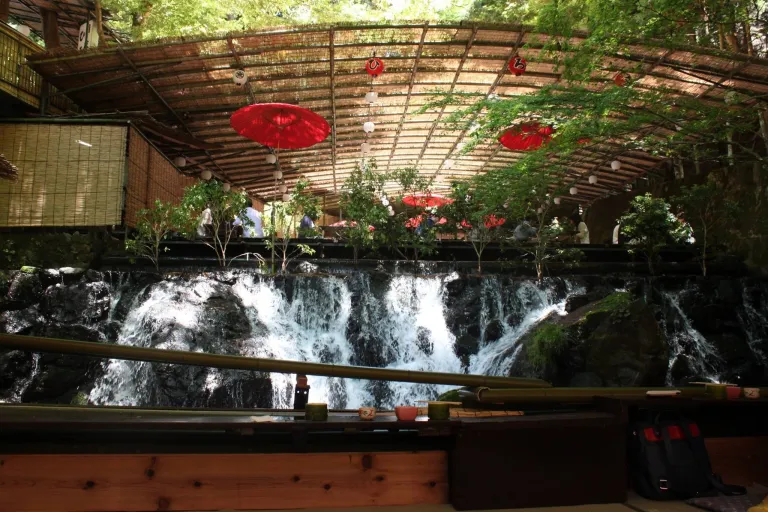
There’s an actual waterfall in Hirobun!
Known as Nagashi Somen, the waiters will slide white somen down streams of cold flowing water through bamboo pipes. Diners will then have to fish out the somen from their designated pipes before dipping it into sauce (like soba). When the red somen appears, that means it’s your final chance! Here’s the catch: The noodles are non-recyclable! If you miss them (the stream flows very quickly by the way), you will just have to leave with an empty stomach.

Delighted with my catch.
Do note that nagashi somen is only served during summer! This is in tandem with Kawadoko – a special Kyoto dining style adopted in summer where diners sit on matted ground next to a river. Here at Hirobun, enjoy the thrill of catching your somen while the refreshing coolness of a small waterfall surrounds you!
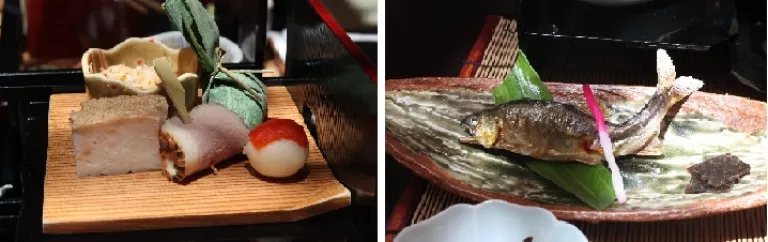
Doesn’t it look too pretty to be eaten? Yakimono – a summer speciality
After all that hiking, there’s definitely more space in your tummy for local delicacies! Hirobun also offers a traditional Japanese set lunch that uses only the freshest seasonal ingredients. The Kaiseki comes with a myriad of exquisite dishes, each flavourful in its own way. In particular, you must try the Yakimono (grilled Ayu fish), a must-have dish in every summer Kaiseki. Tantalising your taste buds, you will feel a rush of fragrant, sweet bitterness as you bite into the fish. By the way, the fish is to be eaten WHOLE, head and tail included. When in Rome, do as the Romans do!
Experience power spots in Kifune Shrine
After lunch, continue to Kifune Shrine, one of Kyoto’s most atmospheric Shinto sites.
The shrine is dedicated to Takaokami, a deity associated with water and rainfall. It serves as the head shrine for numerous water-related shrines across Japan.
The most photographed section is the stone staircase leading to the Main Shrine, lined with red lanterns on both sides.
Inside the shrine grounds, purchase a blank-looking mizu-ura mikuji fortune slip and float it on the sacred water. The written fortune gradually appears as the paper becomes wet.
The shrine remains beautiful throughout the year, from fresh greenery in summer and colourful leaves in autumn to occasional snow in winter.
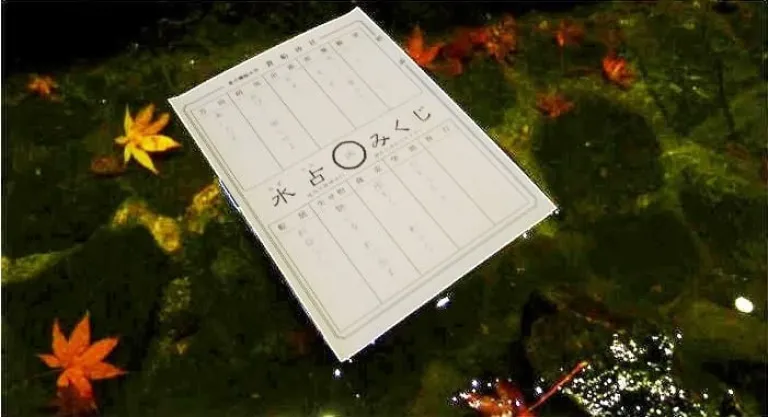
The deities know it all! | Image credit: Ikidane Nippon
Also, if you are concerned with being #foreveralone, Kifune will dispel all your worries. Along the Kifune river and up a slope from the temple’s main hall is Yui no Yashiro, a shrine dedicated to the deity of matchmaking. It is a popular power spot for those seeking true love! Purchase a Musubi-fumi for just 200JPY and write down your desires before tying them on the trees. The deities will be sure to hear you!
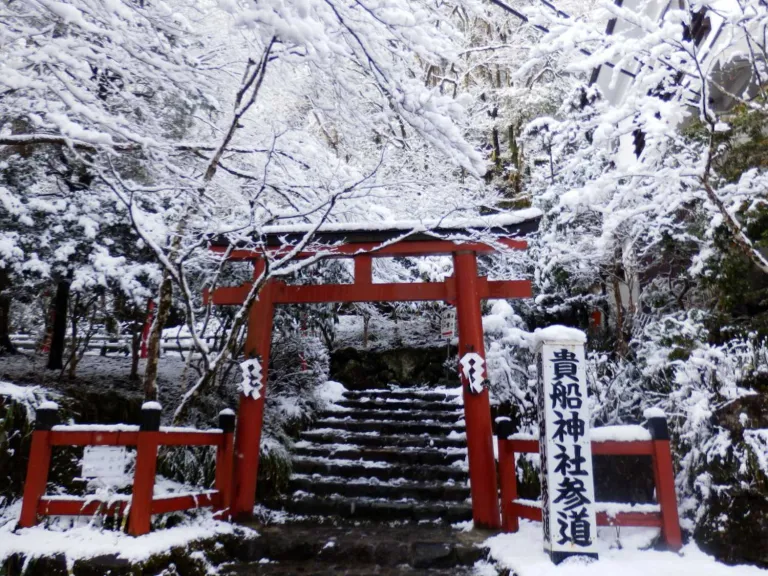
Kifune Shrine during Winter | Image credit: Izu Navi
If one describes Kurama as a noble King protected by his army of mythical creatures, then Kibune is the alluring beauty eager to show off her charm no matter what season. Kifune Shrine is a perfect candidate for scenic photographs, so take all the time you need here to capture these beautiful moments forever.
Enjoy a scenic train ride on Eizan Dentetsu
From the shrine area, travellers can walk or take a local bus towards Kibuneguchi Station.
The walk to the station takes roughly 25 to 30 minutes and follows a narrow road, so the bus is a more comfortable option when services align with your schedule.
Board the Eizan Railway at Kibuneguchi for the return journey to Demachiyanagi Station.
Between Ichihara and Ninose stations, the train passes through the Maple Tree Tunnel, a 250-metre section surrounded by approximately 280 maple trees. The leaves are fresh green during summer and turn brilliant shades of red and orange in autumn.
Selected services use the Panorama Train Kirara, which has large windows designed to showcase the surrounding scenery.
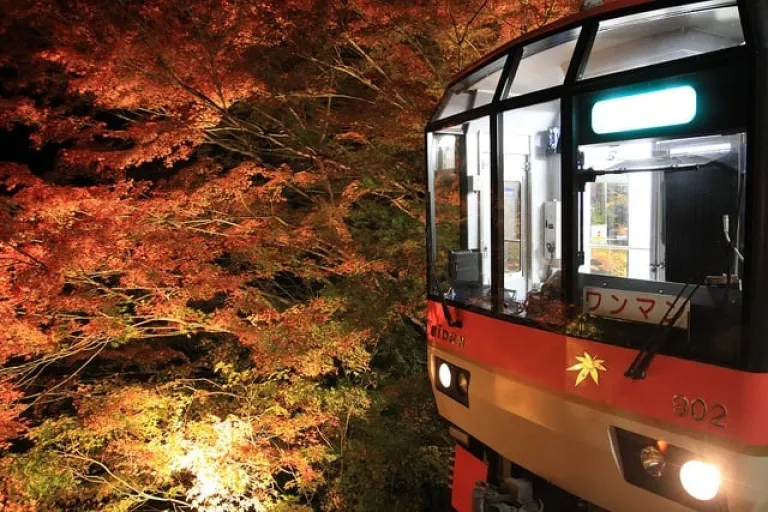
Relish in the last of these stunning mountain views | Image credit: Norio Nakayama
There is so much more to say about Kurama and Kibune, but I will leave you at that. My words can barely do justice to the amazing experiences in these two Japanese villages! So, make sure you visit Kurama and Kibune yourself – it will definitely be an unforgettable adventure.

About Author

Adventurer and athlete, Yi Zhen has a penchant for planning travel itineraries that are off the beaten path. She also daydreams about travelling to Liverpool for the 2019 Netball World Cup.