
Honest Review of Chongqing: Is it Worth It? [Singaporean POV]
From S$ budgets to spice-free eats: here's everything no one tells you before you book.

Chongqing is everywhere on your FYP. Viral clips of trains threading through apartment blocks, nine-grid hotpot glowing under neon lights, and that impossibly atmospheric night view of Hongya Cave (洪崖洞) have collectively landed this city on every Singaporean's China bucket list. Then you scroll through the comments, find someone who says it is overrated, and suddenly you are not so sure.
This is a Chongqing honest review and budget guide for Singaporeans, answering five questions your standard itinerary guide will not touch.
1. Budget: Is Chongqing more affordable than Shanghai or Beijing?
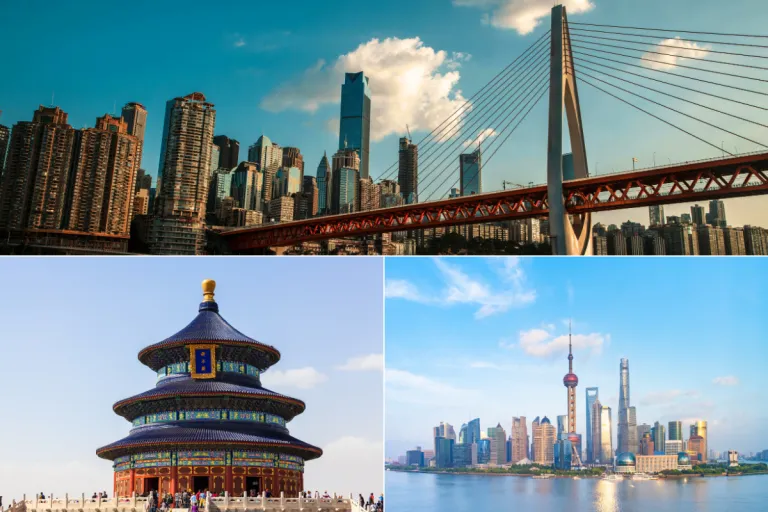 Image credit: DINOE XU (top), Vectortradition via Canva Pro (bottom left), zevei-wenhui via Canva Pro (bottom right)
Short answer: Yes, by a meaningful margin.
Most Singaporeans benchmark China city trips against Shanghai, which deserves its expensive reputation. Chongqing sits firmly in the mid-to-low-budget tier, noticeably cheaper than Beijing, Shanghai and Shenzhen on the ground. During my trip, a coffee cost 15-20 RMB (~S$2.80-3.70), street food snacks ran 7-15 RMB (~S$1.30-2.80) per serving, and I never once spent more than 180 RMB at a sit-down restaurant, even at tourist-facing spots. Public transport was just 2 RMB per ride.
Here is how daily budgets break down:
Budget tier | Daily spend (RMB) | Daily spend (S$) | Who it's for |
|---|---|---|---|
Backpacker | ¥250–400 | ~S$47–75 | Students, solo travellers |
Comfortable | ¥400–700 | ~S$75–130 | Most independent travellers |
Luxury | ¥700+ | ~S$130+ | Premium or business travellers |
Food is where the gap really shows. A bowl of xiaomian (小面) costs around 10-15 RMB (~S$1.50-2.20), which is a third of what you can get at most food courts these days. A hotpot dinner for two runs roughly 150-200 RMB (~S$28-37), about half what you would spend in Shanghai for the same experience.
Return economy flights from Singapore start from around S$438 on Singapore Airlines, with Scoot and connecting itineraries bringing the figure down further. Fly on Tuesdays or Wednesdays and book one to two months ahead for the best fares. A five-day, four-night trip can cost as little as S$650 per person all-in, compared to S$900-1,200 or more for an equivalent Shanghai itinerary.
Verdict: Chongqing wins on value. The flight costs are comparable to Shanghai, but everything on the ground is noticeably cheaper.
2. Hype check: Which places to skip if you're short on time? (洪崖洞, 磁器口古镇, 李子坝站, 十八梯, 解放碑, 武隆喀斯特公园)
This is the section I wish someone had given me before I visited. Not everything viral deserves your afternoon.
Hongya Cave (洪崖洞): Night only
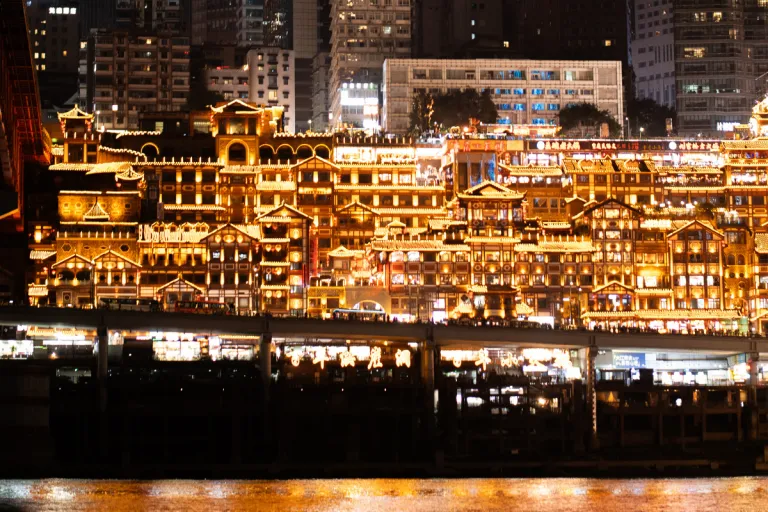 Image credit: TripZilla
Daytime Hongya Cave is a crowded souvenir mall with overpriced trinkets and pushy stall operators. Do not bother with the interior. Instead, head across to Jiangtan Park on the opposite riverbank, you get the iconic tiered view for free, with a fraction of the crowd. Come back after 8 pm, when the structure lights up in neon and looks exactly like every photo you have seen. That version genuinely earns its reputation.
Liziba Monorail Station (李子坝站): Go, but expect crowds
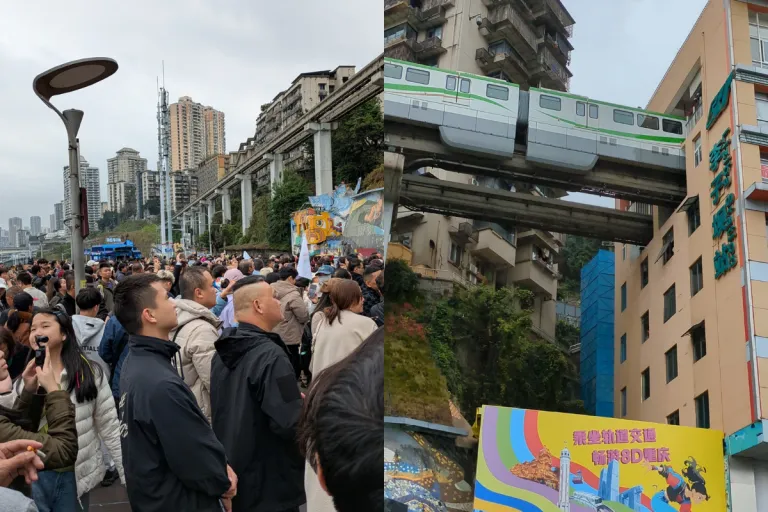
The train-through-building moment is real, and I was sceptical until I saw it with my own eyes. Line 2 passes directly through the 19th floor of a residential block while residents go about their day. Arrive before 9 am or after 8 pm to avoid the worst crowds. At peak hours, it can feel less 'hidden gem' and more 'organised chaos'.
Ciqikou Ancient Town (磁器口古镇): Tourist trap
Ciqikou disappointed me. What was once a historic river trading port is now dominated by bubble tea chains, identical souvenir shops and tourist-trap snack pricing. The one genuinely worthwhile stop is the thousand-year-old Baolun Temple (宝轮寺) tucked inside. Grab a snack, see the temple and move on. The basement food court at Raffles City Chongqing nearby draws the same tourist crowds for the same reason — skip it in favour of a proper local eatery on any surrounding side street.
Shibati (十八梯): Visit neighbouring Shanchengbudao instead
The stilt-house architecture is visually striking and gives a real sense of how Chongqing's old residential quarters once looked. On weekends, however, it is overwhelmingly crowded. Shanchengbudao, right beside it, was far more diverse and contained slices of historical references and residential life.
Jiefangbei CBD (解放碑): Expect severe jams
Do not let the 'shopping district' label put you off. The People's Liberation Monument (人民解放纪念碑), Bayi Food Street for snacks, and the electric night atmosphere make this a strong anchor for your first evening in the city. We spent 20 minutes waiting in traffic.
3. Food: What do you eat if you can't handle spice?
Here is what nobody tells you: Chongqing's food culture runs far deeper than hotpot. Every local noodle shop will adjust the heat on request, say 微辣 (wēi là, mildly spicy) or 不辣 (bù là, no spice) when you order. It is worth noting that Chongqing's spice comes primarily from Sichuan peppercorns, which create a numbing, tingling sensation rather than the burning chilli heat we know in Singapore. Try it at a quarter heat before you write it off entirely.
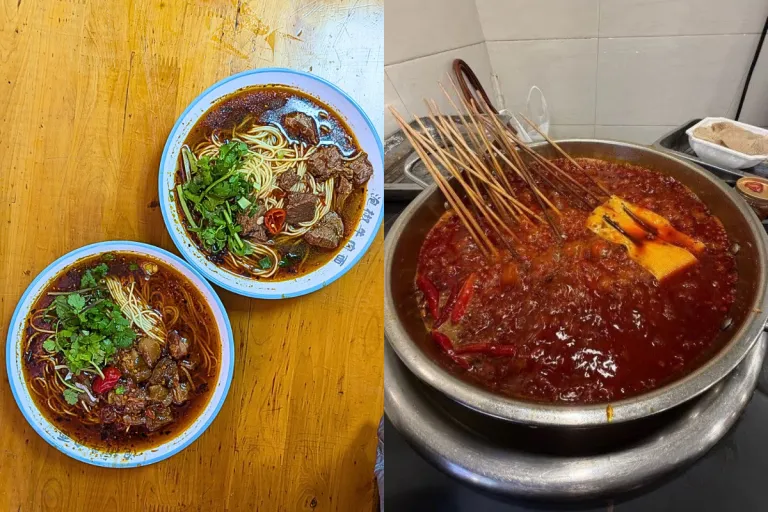
Here is what I ordered, and what I would eat again without hesitation:
Xiaomian (小面) — This is the city's real daily staple. I returned to the same xiaomian shop two nights in a row, which tells you everything you need to know. A bowl costs around 8 RMB (~S$1.50), layered with more than 10 aromatics. Order 不辣 for a clean, deeply savoury result.
Chuan chuan xiang (串串香) — Streetside skewered hotpot; more casual and cheaper than a sit-down session, with far easier spice control. Order clear soup (清汤), try the fried rice, and do not skip their shaved ice desserts.
Xiaosurou (鬼酥肉) — Deep fried pork tenders. Comes with a touch of cumin seasoning. Also has vegetarian versions available.
Dustpan Cake (熨斗糕) — Rice flour pancakes. Best enjoyed toasted. Crispy on the outside, soft on the inside.
Barbeque (烧烤) — Slightly touristy but genuinely tasty, usually served with a sweeping city view. 丁老头 is the most-referenced name locally, though it is harder to reach when the ground is wet. We went to 后山有院 instead and found it every bit as good, without the full uphill climb.
Here's some other well-known recommendations:
Youcha (油茶) — A salty, crispy rice porridge served with fried dough sticks; a traditional breakfast dish that almost no tourist ever tries.
Sauerkraut fish pot (酸汤鱼) — A tangy, sour-broth fish stew with zero spice (think 太二酸菜鱼). A genuinely satisfying alternative to hotpot for heat-averse travellers.
Douhua rice (豆花饭) — Silken tofu pudding served savoury alongside plain rice. Mild and affordable; a good reset after a day of intense flavours.
Steamed pork ribs (粉蒸排骨) and braised pork belly (烧白) — Slow-cooked, rich and completely heat-free. Together, these two dishes make the case that Chongqing's non-mala cooking deserves far more attention than it receives.
TripZilla Tip: Start at 小辣 even if you consider yourself heat-tolerant. Sichuan numbing spice accumulates differently from chilli, and it creeps up on you.
4. Transport: Should you just take Didi everywhere?
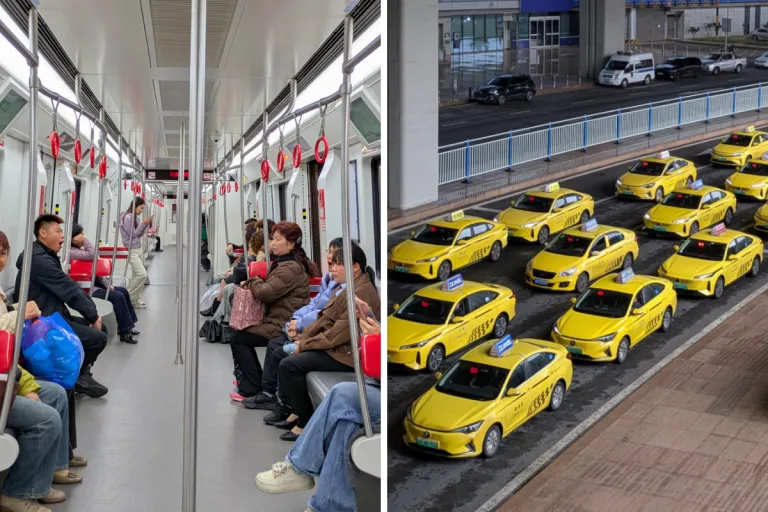
You could, especially in a group, but you would genuinely be missing one of the city's best features. Unlike Singapore's flat, grid-based MRT, Chongqing's Rail Transit (重庆轨道交通, CRT) runs largely above ground, over rivers, and directly through the 19th floor of a residential apartment block at Liziba Station (李子坝站). Riding it is not just logistics; it is part of the experience itself.
Metro (CRT)
12 lines, English signage, bilingual announcements and fares of just 2–10 RMB (~S$0.40–S$1.90). Lines 3 and 10 connect directly from Jiangbei International Airport (重庆江北国际机场) into the city. Pay with Alipay at the gates under 'transport card'. Pick up a transit card at any station for a 20 RMB (~S$3.70) deposit and tap-and-go for your entire trip, just as you would an EZ-Link card back home.
Taxis/Ride-hailing
Essential for airport transfers, late nights and any destination the metro does not reach. I spent ~60 RMB from the airport to Jiefangbei, while others report spending around 80-120 RMB (~S$15-22). Critical tip: have your hotel address in Chinese characters, or open on Amaps when you arrive. Most drivers speak little to no English, and having it ready saves the awkwardness.
Public buses and cable cars
Public buses run at 2 RMB (~S$0.40), and sightseeing routes T002, T003 and T005 link Ciqikou, Jiefangbei and Hongya Cave directly. The Yangtze River Cableway (长江索道) an aerial crossing over the river still used daily by residents.
Verdict: Use Didi for airport transfers and late nights. Take the metro for everything else. Riding Line 2 over the Yangtze at sunset is, genuinely, one of the best free views in the city.
5. Unconventional spots: What's uniquely Chongqing?
Once you have covered the standard tourist circuit, these are the places that show you why Chongqing is unlike any other city in China.
Shancheng Alley and the Mountain City Trail (山城步道)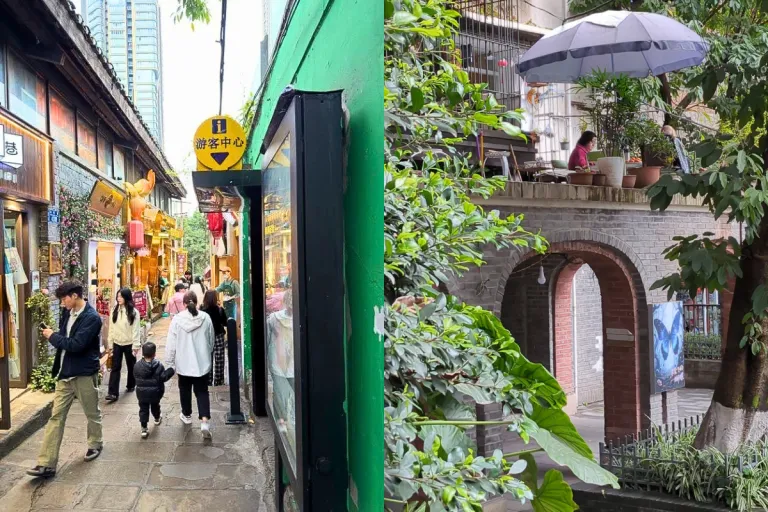
About 1.5 km from Jiefangbei, Shancheng Alley is one of the few old-city corridors that survived demolition and still feels genuinely lived-in. Cobblestone lanes, timber stilt houses, traditional teahouses charging around 15 RMB (~S$2.70) a cup, and none of the chain-store clutter that has consumed Ciqikou. The broader Mountain City Trail passes through it, winding past historic ruins and former air-raid shelters. It was, without question, the most atmospheric walk I did in the entire city.
Baixiangju (白象居)
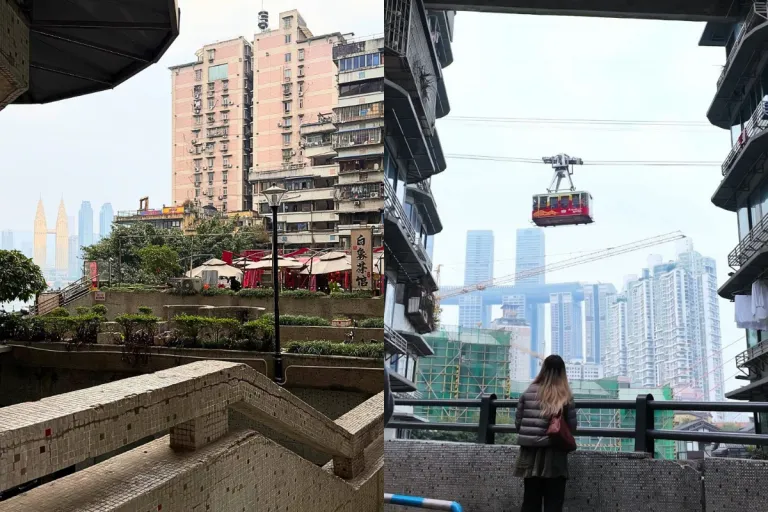
A Soviet-era residential complex famous for its spiralling communal staircases and raw, brutalist aesthetic. There are no lifts, only staircases, and rooftop observation decks offer sweeping views of the Yangtze and Jiefangbei CBD. The whole place looks like a film set, except that people actually live here. Arrive on a weekday morning and you will almost certainly have the stairwells to yourself. Foreign tourists are concentrated around popular photospots, but you'll find fewer of them if you venture away on your own.
Firefly Harbour Rescue Cat Park (萤火虫港湾猫猫主题公园)
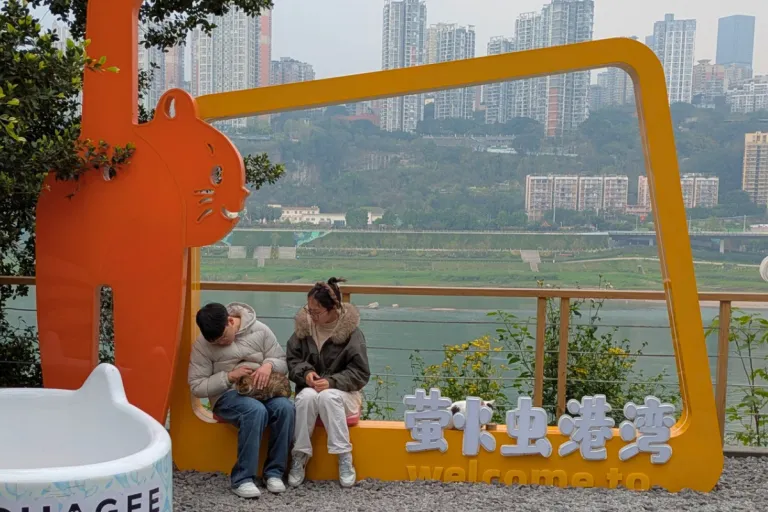
Opened in January 2026 along Nanbin Road in the Nan'an District, Firefly Harbour Cat Park (萤火虫港湾猫猫主题公园) spans 30,000 square metres (roughly the size of four football fields) along the southern bank of the Yangtze River. Every single one of its 500-plus residents is a rescue cat, housed here as part of a genuine adoption drive in partnership with local shelters. Entry costs just 19 RMB (~S$3.60). The cats are generally friendly and roam freely throughout the grounds. Read our review here.
Jingangbei Ancient Village (金刚碑)
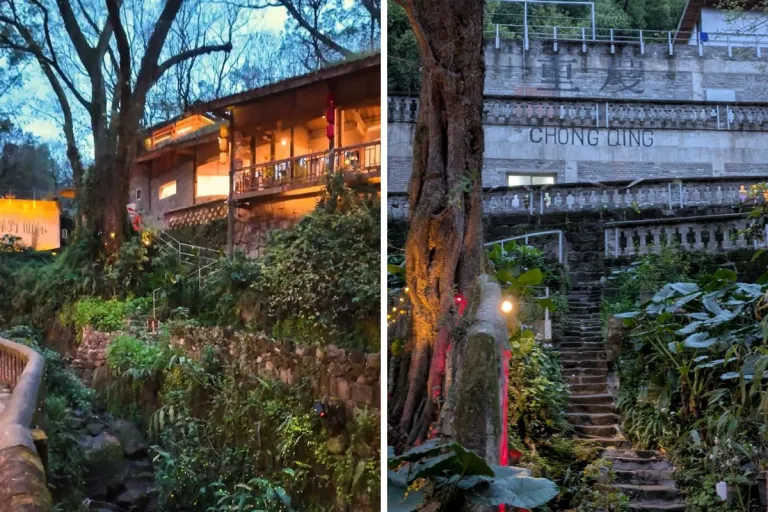
Sitting at the confluence of two rivers at the foot of Jinyun Mountain, this 300-year-old village is the ancient town that all the tourist ones strive to imitate. Banyan trees grow directly into the walls of old timber houses, the lanes are genuinely quiet, and the history is real. Prominent intellectuals and industrialists sheltered here when Chongqing served as China's wartime capital during World War II. The natural hot springs and laid-back countryside vibe nearby make it an ideal half-day escape from the city.
Verdict: Is Chongqing worth the hype?
Here is the honest report card, question by question:
Budget: Yes — cheaper than Shanghai, especially on the ground
Hype: Partially — skip Ciqikou by day and the interior of Hongya Cave entirely, but do not miss the nighttime river view
Food: Absolutely — even for non-spice eaters, the food culture here is wide, deeply affordable and genuinely excellent
Transport: Default to Didi — the metro is an experience in itself, and Line 2 over the Yangtze at sunset is the best free view in the city
Uniqueness: Undeniable — no other city in China looks, moves or feels like this
The viral moments are real, but Chongqing's best experiences are the ones that never make it onto your FYP. A bowl of xiaomian for under S$2. A quiet morning stroll through Shancheng Alley before the crowds arrive. A photoshoot dangling off the 50th floor to end the day. Plan smart, spend less and go further off the beaten path than your algorithm suggests. You won't regret spending your leaves here!
Also read: What Went Wrong With My Alipay In China: How Singaporeans Can Avoid This Mistake
Budgeting and language barrier
How much should I budget per day in Chongqing?
Budget around S$47-75 per day if you are travelling lean, or S$75-130 per day for a comfortable, independent trip with mid-range accommodation and sit-down meals. Food and transport are where the savings are most noticeable compared to other Chinese cities.
Do I need to speak Mandarin to get around?
My non-Chinese-speaking colleague found it challenging to get around. We hardly encountered any locals fluent in English, besides a few attraction staff and restaurant servers. Use WeChat's built-in translation feature to bridge the gap, and knowing 'hello' and 'thank you' is basic courtesy.
P.S. Save your hotel address in Chinese characters on your phone before you land: it will save you considerably when getting a cab from the airport.
Image credits: Dex Quek/TripZilla

About Author

Her motto is "experience everything at least once". An adrenaline junkie at heart, she is always down for spontaneous adventure, especially to exotic destinations. She finds the most meaningful aspect of travel is cultural immersion, and talking to locals is an underrated travel hack.